On Call Garage Doors covers Belmont daily. Springs, openers, cables and off-track doors, same day where we can. Free visit and free written estimate.
A opener that will not run is the fault we are called out for most often in Lincoln, and it is the one homeowners least expect. Nothing wears visibly, nothing sounds wrong, and then one morning the door will not lift and the car is shut in. Around Belmont and Near South we see it concentrated in pre-war near-south homes with detached garages and newer south builds, where deep cold snaps springs and ice bonds the bottom seal to the slab.
The opener does not lift the door either. It nudges a counterbalanced door along its travel and holds it in place. Inside the head there is a nylon worm gear driven by the motor, and that gear is deliberately the weakest link - it is better to strip a gear than to burn out a motor or tear a bracket off a door.
We cover Lincoln and the towns around it - Waverly, Hickman, Malcolm - and the price goes in writing before any work starts. There is no charge for coming out to look, and no charge if you decide against the quote.
A stripped gear has a distinctive symptom: the motor runs, sounds completely normal, and the door does not move at all. If you hear the motor and see nothing happen, that is the gear, and a gear kit is a part rather than a new opener.
If any of that matches, a technician can diagnose it on site in about ten minutes. We do not guess at it down the phone, and we do not charge to look.
Safety reversal is the part that matters. Every opener sold since 1993 has photo eyes near the floor, and if the door does not stop and reverse when the beam is broken, that is not a nuisance fault - it is the safety system not working. We test the reversal on every visit whether it was the reason we were called or not.
The general rule with a door that has failed is to stop using it. Every extra cycle you put through a door with a broken counterbalance transfers load onto parts that were never meant to carry it, and the job gets bigger with each attempt.
If you need the car out before we arrive, release the opener with the red cord only when the door is fully down, and lift with both hands and a straight back. If the door does not move easily, leave it - it is telling you the counterbalance is gone.
People put this off, and it is worth being straight about where that goes. None of the following is unusual - it is the ordinary sequence, and we see it in Lincoln every week.
The visit and the written estimate are free, so finding out where you stand costs you nothing at all. That is the whole reason to call early rather than late.
Deep cold snaps springs and ice bonds the bottom seal to the slab. Split by component, the effect is not evenly distributed:
| Part | What the local climate does to it |
|---|---|
| Torsion spring | Surface corrosion removes section, stress concentrates there, and the spring fails short of its cycle rating. |
| Lift cables | Rust starts at the bottom bracket end, closest to the floor, and works up the lay of the wire. |
| Rollers | Grit and moisture together destroy unsealed bearings; sealed nylon rollers are largely immune. |
| Bottom seal | Hardens, cracks, and stops sealing - after which the weather is inside the garage rather than outside it. |
| Opener | Suffers indirectly. Every one of the above makes the door heavier to move, and the nylon drive gear is what pays for it. |
None of it is exotic and none of it needs a special product. It needs looking at twice a year, which is the part most people in Lincoln skip.
It is worth knowing how the other model works, because it explains most bad experiences with garage door repair.
A national number takes your details and sells them, sometimes to several contractors at once. Whoever calls you first has paid for the privilege, and that cost is in your job before anybody has looked at the door, and why nobody on that line can tell you who is coming or when.
We are the people who turn up. The number on this page reaches somebody who can book the van, and the technician who arrives is the one who quoted it.
The practical difference in Lincoln: an arrival window you can plan around, a written estimate that costs nothing, and a fixed price agreed before any tool comes out.
It does not, and this misunderstanding costs people openers. The spring carries the weight; the opener only moves a weightless door along its travel. An opener that is straining is telling you the spring is wrong, and replacing the opener will not fix it.
Four faults cover most opener call-outs: photo eyes out of line, a stripped drive gear, a drifted limit switch, and a failed board. Three of those are a part and an hour. We tell you which one it is before you spend anything.
Frequency and rolling-code generation both matter. A modern Security+ 2.0 remote will not pair with a 1990s 315MHz head, and vice versa. Read us the model number off the back of the motor unit and we will bring the right one.
None of that is unique to Lincoln. It is simply what happens when a door is quoted over the phone by somebody who has not seen it, and it is the reason we do not give prices before a technician has stood in front of the door.
The difference between a job finished today and a job finished on Thursday is almost always whether the right part was on the van when it arrived. So the van is loaded for what Lincoln actually breaks rather than for a national average.
Springs in the common sizes, lift cables, drums, rollers, hinges, brackets, opener gear kits, remotes, safety sensors and weather seal all travel with the technician. Panels and complete doors are ordered, and we tell you that at the estimate rather than on the day.
It is also why the description you give on the phone matters. Tell us what the door is doing, what it sounds like, whether it is a single or a double and roughly how old it is, and the van leaves already carrying the answer.
You do not need tools and you do not need to touch anything under tension. Stand in the garage with the door shut and look at four things.
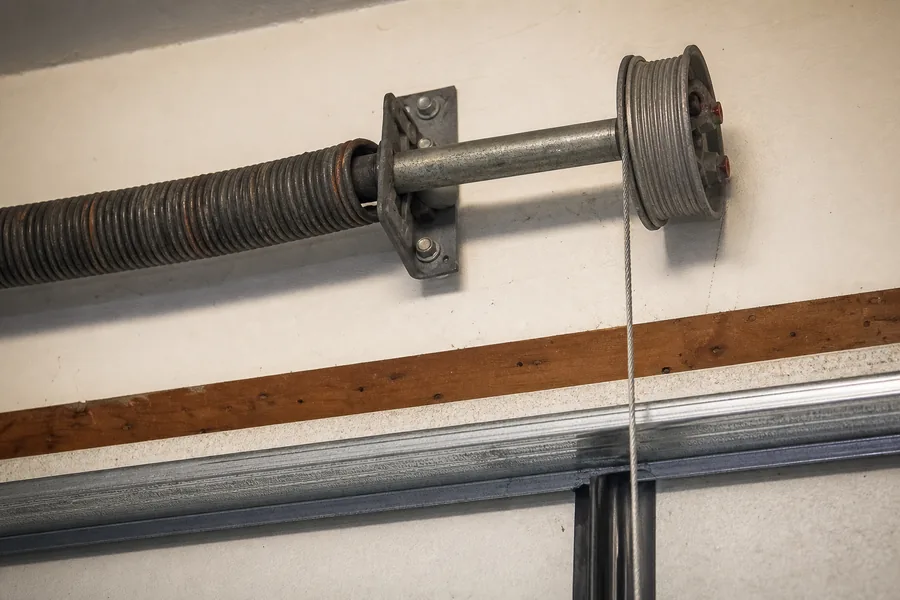
The springs above the door: any orange-brown bloom on the coils is surface rust, and surface rust is where the spring will eventually break. The gap in a broken spring is obvious once you know to look for it.
The cables running down each side: follow them to the bottom brackets and look for strands standing proud of the lay of the wire. Frayed is the warning; snapped is the emergency.
The rollers: spin one with a finger. It should turn freely. A roller that will not turn is dragging in the track and taking the track with it.
And the balance: release the opener with the door down, lift by hand to waist height, and let go. It should stay. Anything else means the counterbalance needs setting.
Almost every residential door in Lincoln is standard torsion hardware, and standard hardware is what the van carries. Two exceptions come up often enough to be worth naming: Wayne Dalton's TorqueMaster, where the spring lives inside the tube, and the direct-drive European heads.
| Brand | Notes |
|---|---|
| Genie | Screw-drive and belt-drive heads. Intellicode remotes and carriage assemblies are the usual failure points, and both are parts rather than a reason to change the opener. |
| LiftMaster / Chamberlain | The same units under two names. Gear kits, logic boards and Security+ 2.0 remotes are stocked, and the older 315MHz heads can still be paired. |
| Amarr | Sections and hardware are widely available and the tracking is standard, which keeps repair costs sensible. |
| Craftsman | Built on Chamberlain internals for most of their production run, so the gear kits and boards are shared and readily available. |
| Wayne Dalton | The TorqueMaster counterbalance is a spring inside the tube rather than on it, and it needs its own tools and its own parts. We carry them. |
| Clopay | The most common door brand we work on. Panels, hinges and struts are orderable individually, so one damaged section does not mean a whole door. |
If yours is not there, it is almost certainly still standard torsion hardware. Read us the badge on the door or the model number off the opener when you call and we will confirm before the van is loaded.

One technician, one van, one job at a time, and the same process whether it is two in the afternoon or two in the morning.
The fault is confirmed on the door rather than guessed at down a phone line. The work is written down before anything is touched. Nothing is added afterwards - if something else is found once the door is apart, it is shown to you and agreed separately.
The door is cycled, balanced and its safety reversal tested before we leave, and the work is warranted in writing. That is the whole of it, across Lancaster County.
We cover the whole of Lincoln, including Belmont, Near South, Havelock, South Lincoln, Williamsburg, and the towns around it - Waverly, Hickman, Malcolm.
Just outside that list is still worth a call. Most of Lancaster County is inside the normal radius, and we will tell you honestly on the phone if you are not rather than booking you in and cancelling later.
Twelve to fifteen years is a fair run for a chain drive, and a belt drive is similar but far quieter about it. What shortens that is rarely age. An opener that has spent a year hauling on a spring that had gone soft has been doing several times its design work every single cycle, and the part that pays for that is a nylon gear.
If a spring or cable has failed, no. Leave it down and do not force it. The counterbalance holds a great deal of stored energy and it can let go without warning.
Yes, in writing, on parts and labor. If the same fault returns inside the warranty period we come back and put it right at no charge.
Usually, yes. We hold same-day slots for Lincoln and the surrounding towns, and a door stuck open or a car shut in goes to the front of the list.
If the opener is over fifteen years old and the board has gone, replacing it is usually the honest advice - a modern head is quieter, has a rolling code remote, and comes with its own warranty. We will say so plainly rather than selling you a board for a unit that is finished.
Yes - card, and everything is documented in writing. Nothing is cash-only and nothing is agreed on the doorstep without it in writing.
Tell us what the door is doing, what it sounds like and roughly how old it is. That is normally enough to know what has failed and what the van needs to bring.
The visit is free, the written estimate is free, and there is nothing to pay if you decide against it. Lincoln, Waverly, Hickman, Malcolm and the rest of Lancaster County.
Rated in cycles, not years, and it uses them faster than anyone expects. When it breaks the full weight of the door lands on a motor built to position it, not lift it.
What this costs and how fast →Four faults cover almost all of it - photo eyes, drive gear, limit switch, logic board. Three of the four are a part and an hour.
What this costs and how fast →A door that comes off once comes off again unless the cause is found. Usually a seized roller, a slipped drum or a loose bracket.
What this costs and how fast →Replaced in pairs, drums reset equally, and sealed nylon rollers where the originals were unsealed plastic. Quieter, and several times the life.
What this costs and how fast →A straight answer on the phone about whether it really needs somebody tonight, and the same parts and labor rates as a Tuesday morning.
What this costs and how fast →Rot or rust across more than one section, or repairs arriving more than once a year. At that point you are buying a door in installments.
What this costs and how fast →