Lincoln, NE
Broken Garage Door Spring Repair in Lincoln
Rated in cycles, not years, and it uses them faster than anyone expects. When it breaks the full weight of the door lands on a motor built to position it, not lift it.
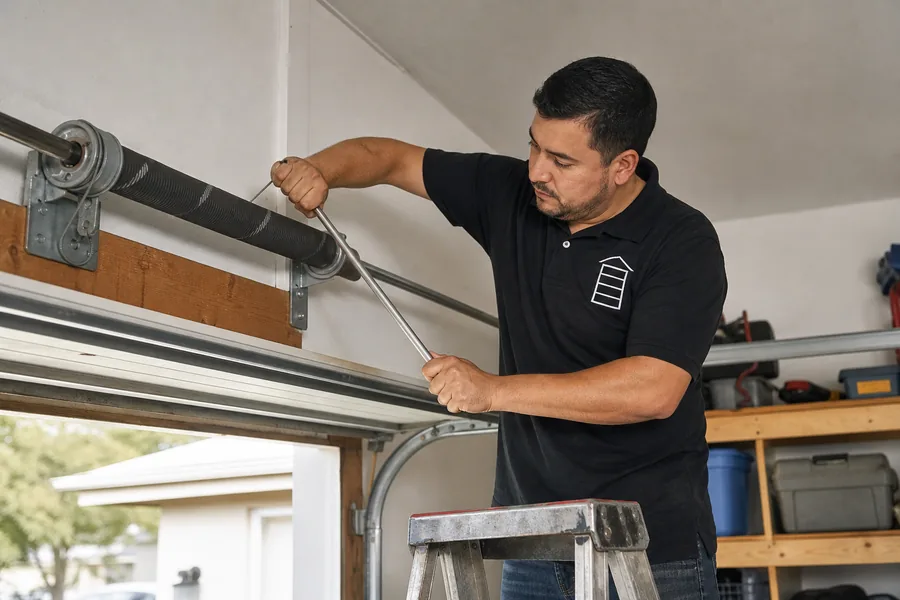
Rated in cycles, not years, and it uses them faster than anyone expects. When it breaks the full weight of the door lands on a motor built to position it, not lift it.
A broken torsion spring is the fault we are called out for most often in Lincoln, and it is the one homeowners least expect. Nothing wears visibly, nothing sounds wrong, and then one morning the door will not lift and the car is shut in. Around Near South and Havelock we see it concentrated in pre-war near-south homes with detached garages and newer south builds, where deep cold snaps springs and ice bonds the bottom seal to the slab.
The spring is not what lifts the door - it is what cancels the door's weight. A double steel door weighs between 130 and 190 pounds, and an insulated one more. Wound tight, the spring stores almost exactly that much energy, so the door behaves as though it weighs nothing and a half-horsepower motor can move it. When the spring breaks, that cancellation disappears at once and the full weight lands on the opener, which is not built to lift it.
Anywhere in Lincoln or Waverly, Hickman, Malcolm, there is no trip fee and no diagnostic fee. If you decide not to go ahead after seeing the estimate, you owe nothing.
The sound is unmistakable if you were home for it - a single flat bang, like a heavy book dropped on a concrete floor. Most people are asleep when it happens, because the metal contracts as the garage cools overnight and that is when a spring at the end of its life gives up.
If any of that matches, a technician can diagnose it on site in about ten minutes. We do not guess at it down the phone, and we do not charge to look.
A residential torsion spring is rated in cycles, not years. The standard spring supplied with most doors is a 10,000-cycle spring, and one cycle is one trip up and one trip down. A household that opens the door four times a day uses about 1,460 cycles a year, so the arithmetic gives seven years. A household with two working adults and a teenager can double that rate and see the spring go in three.
Three numbers define a spring: wire gauge, inside diameter, and length. All three have to suit the weight of your door, which is why the technician measures the old spring and, where there is any doubt, weighs the door. A near-enough spring will lift it. It will also cycle out early, and you will pay the labor a second time.
On a two-spring door both springs went up on the same day and have done the same work since. When one breaks, the other is not fine - it is at the same point in the same life, typically weeks from the same end. That is why the estimate shows both. Take one if you prefer, and the second call-out is on you rather than a surprise.
None of this involves touching anything under tension, and all of it makes the phone call shorter and the estimate more accurate. Two minutes in the garage with the door down is enough.
Whatever you find, do not try to correct it. The value is in the description you give us, not in the repair - a technician arriving in Lincoln who already knows what failed arrives with the right part on the van.
A quote is only comparable if you know what is in it. This is what a broken garage door spring repair in Lincoln covers, every time, whether the invoice is large or small.
The last two items are the ones most commonly skipped, and they are the ones that matter. A door that has not been balanced by hand and had its reversal tested has been repaired, not finished.
A range is a way of not committing. It protects the contractor and tells you almost nothing, and it is why so many garage door jobs end up costing more than the homeowner expected.
We do it the other way round. The visit costs nothing, the technician sees the actual door, and you get one number in writing for the work described. If you want to think about it, or get another quote, that is normal and there is no charge for having wasted anybody's time - you did not.
The number depends on real things: door weight, spring specification, what else broke when the first thing broke, and whether the job is one side or two. Nothing in that list can be known down a phone line, which is the whole reason the visit is free.
That applies across Lancaster County and the towns around it, at any hour.
This is the one repair on a garage door that genuinely hurts people. A wound torsion spring holds enough energy to break the bones in a hand, and the winding bars have to be held against that load while the set screws come loose. It is not a matter of being careful. It is a matter of having the right bars, the right cone, and having done it enough times to know how the load moves.
There is no safe way to keep using it, and there is no prize for trying. Load that should be on the counterbalance goes somewhere else instead - hinges, brackets, the opener's gear - and each of those is a bigger bill than the part that actually failed.
If the car has to come out, do it with the door fully down and the opener released. A partly-raised door with no working spring will finish the journey by itself.
Nothing here is an upsell. Each one genuinely changes what the work involves, and each one has to be looked at rather than assumed.
| Factor | Why it matters |
|---|---|
| Door age | On a door old enough that panel sections are no longer made, we will say so before you spend on a spring. |
| Torsion versus extension | Older doors with springs along the side tracks are a different job, and safety cables are non-negotiable on them. |
| Bearing and shaft condition | A worn center bearing puts the next spring out of true. Cheap to deal with while the shaft is exposed and expensive afterwards. |
| Collateral damage | A spring that let go can take a cable, a drum or a bearing plate with it. That is found on the visit and quoted before it is done. |
| One side or two | Two-spring doors age together. Doing one now and one in a month means paying the labor twice. |
That is the whole list. There is no separate call-out, no diagnostic charge and no paperwork fee waiting at the end of it.
There is a point at which putting parts into a door is throwing money at it, and there is a point well before that at which a salesman will tell you there is. These are the lines we actually use.
| Situation | What we recommend |
|---|---|
| Door is off its track after an impact | Repair first. Realign, find the cause, and only then judge whether panels are sound. |
| Wooden door that has begun to swell and bind | Depends entirely on the frame. Worth a look before you commit to either. |
| Repairs arriving more than once a year | Replace. You are paying for a new door in installments and not getting one. |
| Damage or rot across two or more panels | Replace. Section-by-section repairs stop making financial sense at that point. |
| Opener over fifteen years old, board failed | Replace the opener only. A modern head is quieter and carries its own warranty. |
| Single-skin door on a garage you use as a room | Replace, and specify the insulation. R-value is the difference you notice daily. |
The short version: the mechanism is consumable and the door is not. Springs, cables and rollers get replaced across a door's life as a matter of course. Panels are the thing that decides whether the door itself is finished.
You do not need tools and you do not need to touch anything under tension. Stand in the garage with the door shut and look at four things.
The springs above the door: any orange-brown bloom on the coils is surface rust, and surface rust is where the spring will eventually break. The gap in a broken spring is obvious once you know to look for it.
The cables running down each side: follow them to the bottom brackets and look for strands standing proud of the lay of the wire. Frayed is the warning; snapped is the emergency.
The rollers: spin one with a finger. It should turn freely. A roller that will not turn is dragging in the track and taking the track with it.
And the balance: release the opener with the door down, lift by hand to waist height, and let go. It should stay. Anything else means the counterbalance needs setting.
Less than the industry likes to imply. Torsion hardware is torsion hardware, and a spring, a cable and a roller are the same components whoever stamped the panel. Where the brand does matter is parts availability and a handful of proprietary designs.
| Brand | Notes |
|---|---|
| LiftMaster / Chamberlain | The same units under two names. Gear kits, logic boards and Security+ 2.0 remotes are stocked, and the older 315MHz heads can still be paired. |
| Clopay | The most common door brand we work on. Panels, hinges and struts are orderable individually, so one damaged section does not mean a whole door. |
| Craftsman | Built on Chamberlain internals for most of their production run, so the gear kits and boards are shared and readily available. |
| Amarr | Sections and hardware are widely available and the tracking is standard, which keeps repair costs sensible. |
| Wayne Dalton | The TorqueMaster counterbalance is a spring inside the tube rather than on it, and it needs its own tools and its own parts. We carry them. |
| Chamberlain myQ | Wi-Fi hubs and the app side fail more often than the mechanics do. Usually a re-pair rather than a replacement. |
The model number is usually on a sticker on the side or the back of the opener head, and on a plate inside the top section of the door. Read it out when you call and the van leaves with the right parts.
Springs on a two-spring door are wound the same number of cycles and age together. If one has gone, the other is at the same point in its life and is usually weeks behind. Replacing one and leaving the other means paying the labor twice, which is why we quote both and let you decide with the numbers in front of you.
Most broken garage door spring repair jobs are finished within the same visit, typically under two hours.
Usually, yes. We hold same-day slots for Lincoln and the surrounding towns, and a door stuck open or a car shut in goes to the front of the list.
Yes - card, and we issue a written invoice for every job. Nothing is cash-only and nothing is priced on the doorstep.
No. The visit and the written estimate are free anywhere in Lancaster County. You pay only if you agree the price and we do the work.
Yes, in writing, on parts and labor. If the same fault returns inside the warranty period we come back and put it right at no charge.
One call gets you a two-hour arrival window rather than a day, and a technician who rings before setting off. No lead auction, no bidding, no stranger quoting your door by phone.
Free visit, free written estimate, fixed price agreed before anything is touched. Throughout Lincoln and Waverly, Hickman, Malcolm.
A two-hour window rather than a day, and a call before the technician sets off. Free throughout Lancaster County, with nothing to pay if you decide against the quote.
Prefer to talk it through? Call (402) 897-1796.
Before you buy a new one: an opener that strains is usually reporting a spring problem, not an opener problem. Replacing the head will not fix that.
What this costs and how fast →Rollers reseated, hinges checked for the damage a derailment hides, and the track trued against a level. Then we find what put it there.
What this costs and how fast →One cable slack, one taut, and the door sitting crooked. Cables carry the door's whole weight to the spring, so this one does not wait.
What this costs and how fast →A straight answer on the phone about whether it really needs somebody tonight, and the same parts and labor rates as a Tuesday morning.
What this costs and how fast →Insulation is the specification you notice daily: R-0 to R-2 bare, R-6 to R-9 polystyrene, R-12 to R-18 polyurethane. Stiffer and much quieter.
What this costs and how fast →