
Swing and sliding driveway gates, the operators that move them, and the keypads and sensors that tell them to. Same day.
Tell us what the door is doing. The estimate is free and you can say no.
If your gate has stopped, slowed, sagged or started making a noise, this is the page. We repair swing gates and sliding gates around Lincoln, the operators and arms that move them, the hinges and posts that hold them up, and the keypads, remotes and sensors that tell them what to do.
Most of the gates we see are not exotic. A pair of iron leaves on a linear arm, an aluminum slider on a chain drive, a steel gate on a rack and pinion. What they share is that they live outdoors, carry real weight, and get ignored until the morning they will not open.
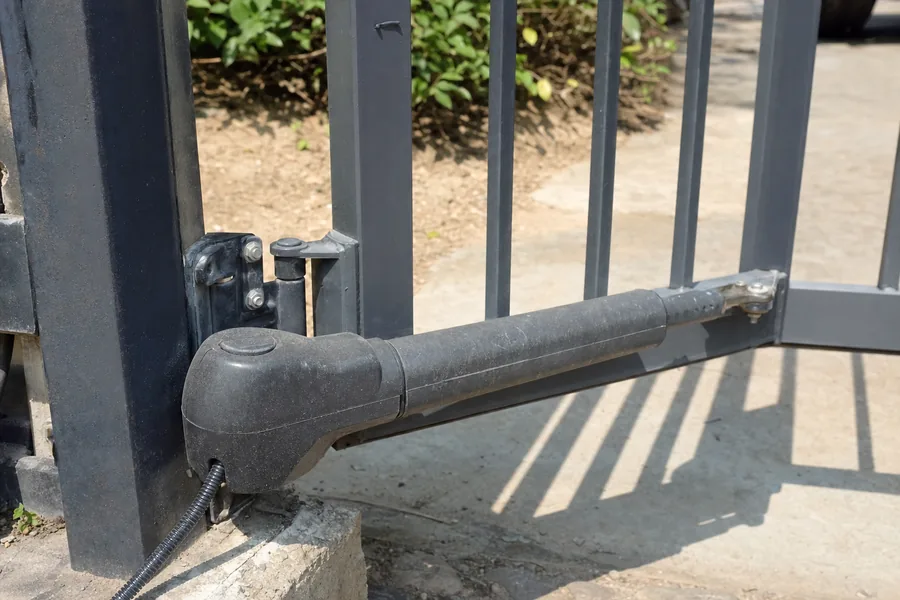
An automatic gate has more parts that can stop it than a garage door does, and they fail in a fairly fixed order. This is what we find, most to least often.
A residential operator is rated for a gate that swings freely by hand. Disconnect the arm on most gates we are called to and the leaf will not move without a shove. A hinge pin has worn, the post has heaved with the ground, or the leaf has sagged until the latch side scrapes. The operator has been dragging that load for months, and the board or the motor is the part that finally gives up.
So we do not start at the operator. We release it, swing the gate by hand, and put a level on it. Fix the hinge or the post and half the time the original operator is fine. Replace the operator on a gate that binds and you have bought the same failure again.
Lincoln has hard plains winters, and a gate stands in it all year with no roof over it. Where deep cold snaps springs and ice bonds the bottom seal to the slab, a gate feels the same forces on parts that are smaller and more exposed than anything on a garage door. Hinge pins, roller bearings and the rubber of a safety edge all age faster outdoors.
The ground matters as much as the sky. A post set shallow moves with the seasons, and every fraction of an inch at the post is an inch at the latch. On sliding gates the concrete pad under the operator and the track itself shift the same way, which is why a gate that ran perfectly in one season binds in the next.
Most gate repairs are done in the same visit because the parts that fail are the parts we carry.
Half of the calls that begin as a broken gate end as a broken control. A keypad with a dead battery, a remote the receiver has forgotten, an intercom that rings the house but no longer releases the latch, an exit loop with a cracked wire under the driveway. We program remotes and keypads, replace receivers, repair loop detectors, and connect phone-entry and app-based access to operators that support it.
Safety is part of that. A gate that closes on a car or a child is not a convenience problem, so photo eyes and safety edges are checked on every visit whether or not they were the complaint.
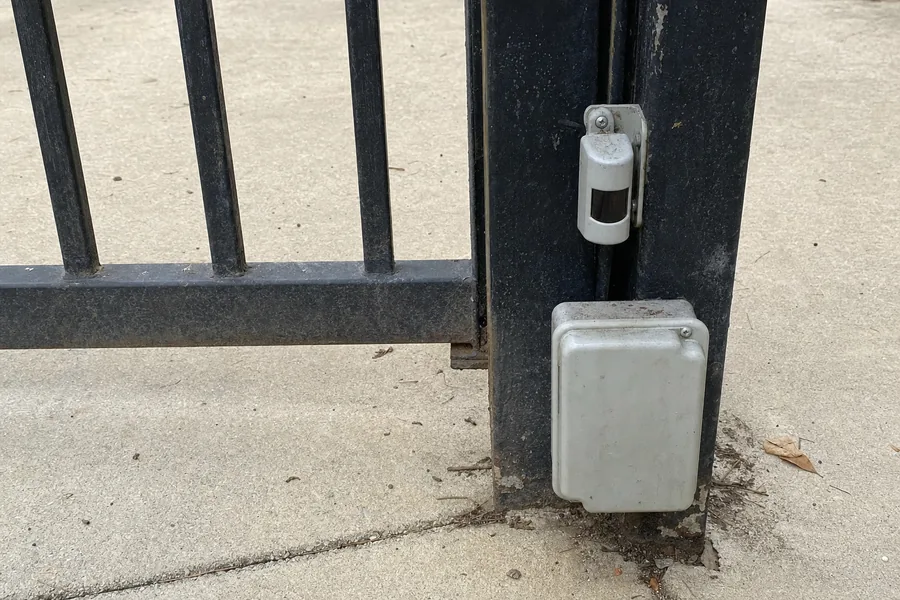
Most operators are worth keeping. A board, a battery, a limit adjustment, a new arm or chain, and the same machine runs for years. The cases for a new one are specific: a motor that has burned, a brand whose parts are no longer made, an operator undersized for the gate it is on, or one so old that no current safety device will connect to it.
When it is a new operator, we size it to the gate's real weight and length rather than to the box the old one came in, and we match swing to swing and slide to slide. Solar and battery-only units are an option where there is no power at the gate.
Most residential gates here run on LiftMaster, Mighty Mule, Nice or Apollo, Viking, DoorKing, Linear, Elite, FAAC, GTO or Ghost Controls. We service all of them and replace the ones that cannot be saved. The parts that fail most, boards, batteries and arms, travel with us for the brands we see most in Lincoln.
Three things are worth trying, and none of them involves the operator's cover. Check the breaker or the plug at the gate. Change the remote battery. Look along the line of the photo eyes for a web, a leaf or a bin someone left in the way. If the gate is stuck shut and you need out, every operator has a manual release, usually a key or a lever on the arm, and it is safe to use.
What is not worth trying is forcing the gate against the arm. That bends the arm, strips the gear and turns a small repair into a bigger one.
A gate that will not move at all, hums, opens halfway or ignores the remote is usually the operator, not the gate. The motor, control board, power supply, battery or solar unit, photo eyes, remotes and keypads have their own page: electric gate opener repair in Lincoln.
Nine times out of ten a photo eye or safety edge. Something is in the beam, the eye has been knocked out of line, or it has failed. It is a safety device doing its job, and it is a quick fix.
Most of the time, yes. The parts that fail most often are on board for the brands we see most. Where something has to be ordered you hear it from the technician on the spot.
We treat it as one. A property open to the street gets the same priority as a garage door that will not close, and if the gate cannot be fixed that visit it is secured shut until it can.
Most of the time. Operators fail in parts, and parts get replaced. The exceptions are a cooked motor, a discontinued brand, and an operator that was undersized for the gate to begin with.
Yes, if the gate swings or slides freely by hand and the posts are sound. We check both first, because an operator on a gate that binds does not last.
Yes, and receivers, intercoms, phone entry and loop detectors as well. Control faults are a large share of gate calls and rarely need a new operator.
More, if anything, because they live outdoors. Once a year: hinges and rollers lubricated, track cleared, battery tested, photo eyes and reversal checked, force settings confirmed.
Around Lincoln, one call gets you a two-hour slot and a heads-up call before the technician sets off. We don't buy leads and nobody on a phone judges a door they can't see.
Free estimate across Lincoln, NE and the towns around it.
Describe the symptoms and you'll get an arrival window, not a guess. The visit and the estimate is free, anywhere in Lancaster County.
Easier to explain by phone? Call (402) 897-1796.
Tell us what the door is doing. The estimate is free and you can say no.